
A Christmas preparation checklist is easier to finish when it follows the order things actually happen: the tree goes up, the lights go on, gifts and stockings get filled, the table and the baking come together, and a winter storm may or may not interrupt all of it. This post walks through that order as of Nov 22, 2026, tells you what to check at each step, and points to the Natural Picks guide that covers the buying decision for each one. It is an information post, not a ranking: the rankings live in the guides.
Key takeaways
- Check the tree, the stand and the lights before anything else. They are the items on this list that are plugged in, left on and sit near people.
- Read the age label and the safety text on every kids’ gift, not only the title. On some listings the title, the bullets and the safety text give different ages.
- Anything with a small round battery needs a screw-closed battery door. The Consumer Product Safety Commission (CPSC) says a swallowed button battery can burn through a child’s throat or esophagus in as little as two hours.
- Do one outage check before the holidays: working flashlights, charged power banks, and carbon monoxide detectors on every level of the house.
- Our 13 Christmas guides each cover one purchase. The table near the end of this post shows which guide answers which question.
When should a Christmas preparation checklist start?
The honest answer is: earlier than the decorations. The tasks that take the longest are the ones that depend on other people or on shipping, such as gifts for children, matching a tree stand to a tree, and any item you plan to give as a present. The tasks that are quick but easy to forget are the safety checks, which take minutes and are best done the day the boxes come out of storage.
A workable order for a Christmas preparation checklist looks like this:
- First: decide which gifts you are buying, because age labels and shipping take the most time to sort out.
- Before decorating: test every light set and check the tree stand against the tree.
- The week you decorate: check the smoke and carbon monoxide alarms and put candles and cords where they cannot be reached or tipped over.
- Before the meals and baking: sort the table linens, the baking pans and the tools you only use once a year.
- Before the weather turns: run the outage check described below, so a storm does not turn into a scramble.
None of this requires buying anything new. Most households will find that the checklist is mostly about inspecting what they already own, then filling a small number of gaps. When you do buy, the five-minute guide to reading an Amazon listing shows the lines worth reading first.
What should you check on the tree and the tree stand?
Start with what kind of tree you have, because the checks differ.
A live tree
CPSC’s holiday decorating release, published Dec 16, 2008 and still the clearest short list from the agency, describes a fresh tree as green, with needles that are hard to pull from the branches and do not break when bent between your fingers. The cut end should be sticky with resin, and a tree tapped on the ground should not drop many needles. Place it away from fireplaces, vents and radiators, because heated rooms dry a live tree quickly, and keep the stand filled with water.
That last point is where the stand matters. In our comparison of Christmas tree stands for real and artificial trees, one plastic stand lists a trunk size of up to 4 inches but a water capacity of 1.5 quarts. We flagged that as small for a trunk at the top of its stated size, because a stand that empties quickly is a stand that needs refilling more often. The rule of thumb is simple: look at the trunk of the tree you actually bought, then compare it with the trunk size and water capacity the stand states, not with the tree height.
An artificial tree
CPSC advises looking for a “Fire Resistant” label on an artificial tree and adds the caveat that the label does not mean the tree will not catch fire. It only means the tree is more resistant to burning. Listings rarely make this easy. When we read three pre-lit trees for our artificial Christmas tree comparison on Nov 8, 2026, one listing said its lights were “UL-listed” but gave no UL file number and no flame standard, another said “flame-retardant branch tips” and named no UL listing, and a third described its lights as “warm white and multicolored” in the title but “multicolored LED” in its first bullet. None of that proves a tree is unsafe. It does mean the claim cannot be checked from the page, which is why we score the listing’s disclosure and not our assumptions.
For tall artificial trees the stand matters too. The folding stand we read states the tree heights and center-pole sizes it fits, but does not state the steel gauge or where it is made. Match the pole diameter first.
One more CPSC point: do not use electric lights on a metallic tree. A fault in the lights can charge the tree, and a person touching a branch could be shocked.
What should you check on Christmas lights, inside and out?
Light sets cause more confusion than almost any other seasonal purchase, because three different claims get blended in listings: a safety listing (UL or ETL), a weather rating (a number such as IP55), and a connection limit. They are separate facts and each needs its own check.
Safety testing
The CPSC release advises using only lights tested by a nationally recognized testing laboratory, such as UL or ETL, and newer sets with thicker wiring and safety fuses. For a new set, look for the mark on the cord tag or box. On a listing, look for the wording and then ask whether a file number is given. In our outdoor Christmas lights comparison, one 50-foot set states “UL listed with a fused plug” and an IP55 water rating, yet no UL file number appears on the page. Another set’s “UL Indoor/Outdoor” wording came from the search-result title, not from the bullets. Those are the kinds of details worth knowing before you hang anything on a gutter.
Condition of the sets you already own
CPSC says to check each set, new or old, for cracked or broken sockets, frayed or bare wires and loose connections, and to throw out damaged sets. Plug each one in on the floor before it goes on the tree or the house.
Outdoor use
Outdoors, use only lights certified for outdoor use, plug them into a ground-fault circuit interrupter (GFCI) outlet or a portable GFCI, and use an extension cord rated for the job. Add up how many sets you plan to connect, because every product states its own limit. One set we read connects up to 21 strings, and another states up to 45 sets end to end, which is a limit of 2,250 bulbs (45 sets of 50). Exceeding the stated limit is a common way to overload a run.
If you are lighting an indoor tree or a mantel rather than a house, the Christmas LED string light comparison covers lit length, how many strands connect, UL wording and the listing errors we found. Turn all holiday lights off when you go to bed or leave the house.
What should you check in the home before guests and children arrive?
This is the shortest part of any Christmas preparation checklist and the one people skip. Do three things.
- Test the alarms. Ready.gov advises carbon monoxide detectors with battery backup in central locations on every level of the home. If yours are old or you are unsure which type you have, the smoke and carbon monoxide alarm comparison explains the standards named on the listings.
- Move the flame. CPSC’s advice for candles is to keep them in sight, away from trees, evergreens, decorations, curtains and furniture, in non-flammable holders, and out before bed.
- Keep paper out of the fireplace. CPSC says not to burn wrapping paper or plastic in a fireplace, because they can ignite suddenly and burn intensely, and to use a screen to stop sparks.
For scale, the same CPSC release states that about 11,000 people are treated in hospital emergency rooms in the 60 days around the winter holidays for decoration-related injuries, with falls, cuts, shocks and burns topping the list. It also quotes an estimate from the National Fire Protection Association of 240 fires a year involving dried-out Christmas trees, with 16 deaths and 13 million dollars in property damage. These figures date from 2008. We could not confirm newer National Fire Protection Association numbers from a primary page, so we are not quoting any, and the point stands without them: the checks take minutes.
What should you check on kids’ gifts, advent calendars and stockings?
For children’s gifts, the check that matters most is also the least glamorous: read the age label and the warning text, and see whether they agree.
Age labels that disagree
In our stocking stuffer comparison, one reusable sticker pad is titled “Ages 4”, a bullet recommends it for 3- to 8-year-olds, and the safety text says “Not for children under 3”. A child who is three fits two of those three statements. That is why we list the age label separately in every kids’ guide, and why we recommend treating the strictest statement as the one to follow. A wax-and-yarn travel toy in the same guide carries “Choking Hazard: Bag” in its safety text, a reminder that the packaging can be the hazard.
Advent calendars
Advent calendars come in two kinds: those with a gift behind each door, and those where a toy builds across the 24 days. The numbers differ a lot. In our toy advent calendar comparison by age, a car calendar lists 24 doors with 34 pieces and says it is not for children under 3, one building calendar lists 290 pieces for ages 5 and up, and another lists 211 pieces for ages 6 and up. If you would rather skip candy, the non-candy Christmas advent calendar comparison covers LEGO, Playmobil and wooden options.
Button batteries
Many light-up gifts, ornaments and remotes use small round batteries. CPSC’s guidance is to look for screw closures: toys with button cell or coin batteries are required to have a secure closure that needs a screwdriver, coin or tool to open, and the agency advises keeping products without that kind of closure away from children. When a battery is removed, put non-conductive tape such as electrical tape over its terminals and discard it at a battery-collection center. If a child may have swallowed a battery, CPSC says to seek medical attention immediately and lists the National Battery Ingestion Hotline at 800-498-8666 and the Poison Help Line at 800-222-1222. General information, not medical advice.
Where to look for the gift itself
- Toddlers: the wooden toys for toddlers comparison covers age grade, finish and recall records.
- Ages 3 to 5 without a screen: the screen-free gifts for ages 3 to 5 comparison.
- Favorite characters: the character-themed gifts for preschoolers comparison.
- Adults with sensitive skin: the fragrance-free skincare gift set comparison, which looks at ingredient lists and hidden fragrance.
What should you check for the Christmas table and the baking?
This is the lowest-risk part of the checklist, and mostly a matter of sizing and materials rather than safety.
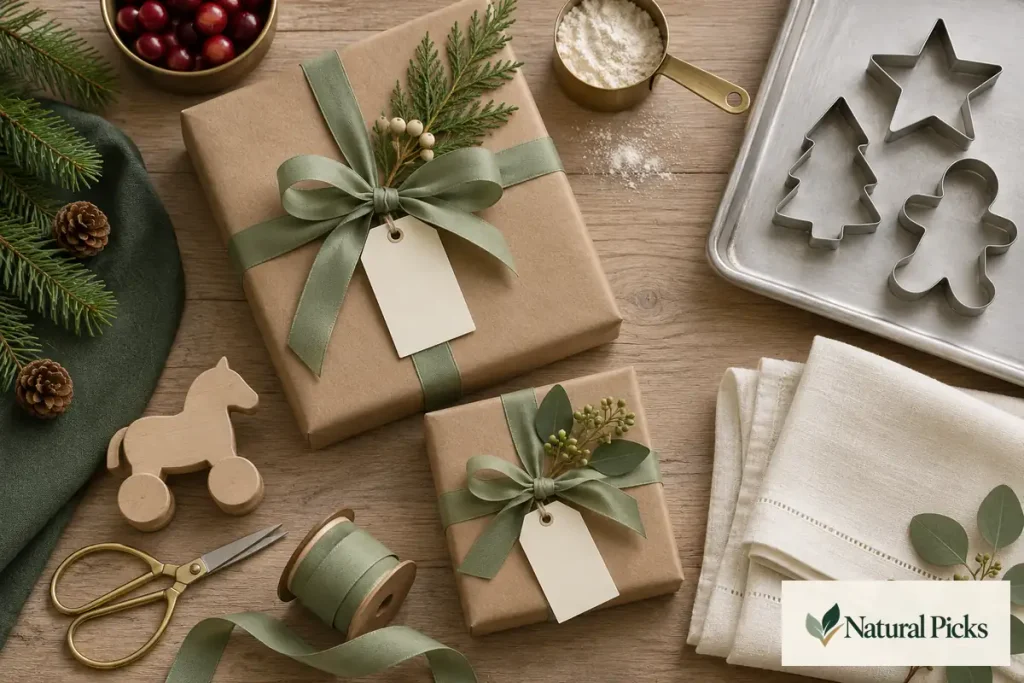
The table. Measure the table before you order linens. A tablecloth that is listed in inches needs to be compared with your table, with enough drop on each side. The Christmas table linens comparison notes that a linen tablecloth and linen napkins from the same seller name certifications such as OEKO-TEX Standard 100 with no certificate numbers. A certification named without a number is a claim you cannot check from the listing. The guide to checking a certification claim shows how to look one up yourself.
The baking. Sort your pans first. Look at the sheet pans you own for warping or worn coating before a batch of cookies, and then decide what is missing. Our Christmas cookie baking sheet comparison covers stated materials, sizes and origin claims, and the cookie cutter and baking tool comparison covers what each listing states about materials and sizes. If you bake in volume, the stand mixer comparison for holiday baking compares stated wattage, bowl size and accessories.
A small habit saves time here: write the cookie recipes on one page, count the pans and racks they need at the same time, and check that number against the oven you have.
What should you check for winter outages and holiday travel?
Winter storms do not wait for the holidays to be over. Ready.gov’s power outage page, last updated Jun 4, 2026, gives a short list worth putting on the checklist.
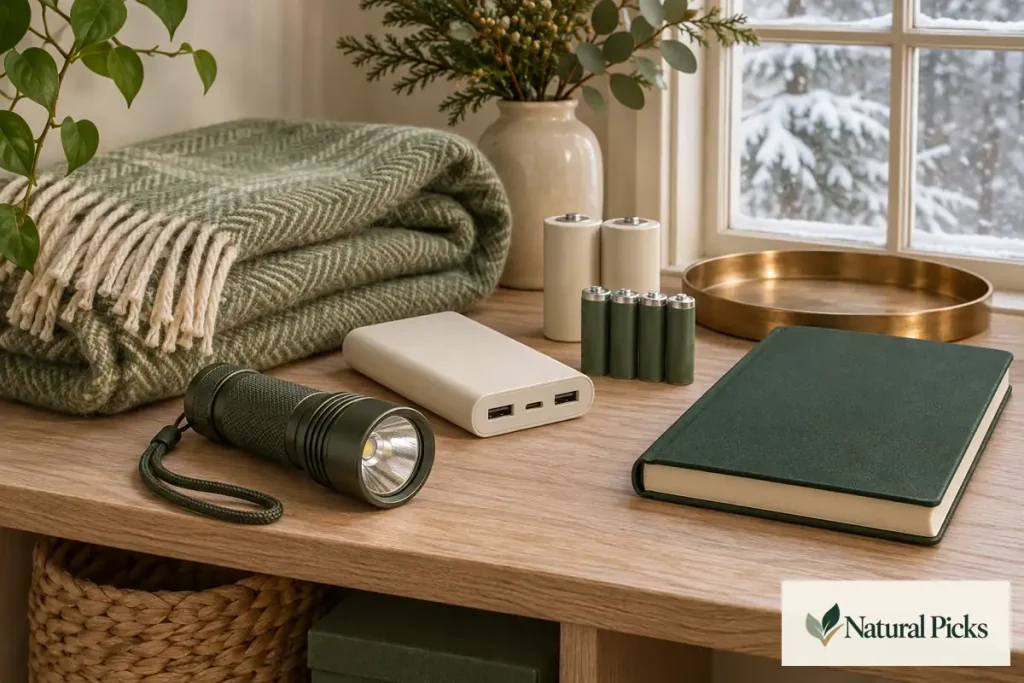
- Light: flashlights for every household member.
- Power: take an inventory of what needs electricity, and plan batteries or a portable charger or power bank for those items. Also check whether a home phone will work in an outage and for how long its battery backup lasts.
- Food: a refrigerator keeps food cold for about four hours and a full freezer for about 48 hours if the doors stay closed. Throw out food that has reached 40 degrees Fahrenheit or higher.
- Heat: never use a gas stovetop or oven to heat the home, and use generators, camp stoves and charcoal grills outdoors only, at least 20 feet from windows.
- Medical needs: talk to your medical provider about any electrically powered medical devices or refrigerated medicines.
If you want to buy for outages, we have separate comparisons for rechargeable lanterns for winter outages, portable power stations for winter outages and power banks for winter emergency kits. If you already own a power bank, our post on how to check whether a power bank has been recalled takes a few minutes. If you drive to see family, the winter car emergency kit checklist lists what to carry and what to buy separately.
Where does each Christmas guide fit?
As of Nov 22, 2026, the Christmas category lists 13 buying guides. Here they are in checklist order, with the one question each guide answers. Related guides outside the category that this post links to are in the sections above.
| Checklist step | Guide | The question it answers |
|---|---|---|
| Tree | Artificial Christmas trees | What does each pre-lit tree listing say about lights, UL and flame wording? |
| Tree | Christmas tree stands | Does the stand fit the trunk or pole, and hold enough water? |
| Lights | Outdoor Christmas lights | What are the weather and UL claims and the connection limits? |
| Lights | Christmas LED string lights | How long is the lit length and how many strands connect? |
| Kids | Toy advent calendars by age | Which calendar fits which age? |
| Kids | Non-candy advent calendars | What are the options beyond candy? |
| Kids | Stocking stuffers for kids | Which small gifts have consistent age labels? |
| Kids | Wooden toys for toddlers | What are the age grade, finish and recall records? |
| Gifts | Fragrance-free skincare gift sets | Which sets avoid hidden fragrance? |
| Table | Christmas table linens | What fiber and certification claims are stated? |
| Baking | Cookie baking sheets | What are the stated materials and sizes? |
| Baking | Cookie cutters and baking tools | What do the listings state about materials? |
| Baking | Stand mixers for holiday baking | How do wattage, bowl size and accessories compare? |
Every guide is a research-based comparison: we read what each seller or source puts in writing, check records where one applies, and score the listing. We did not test these products ourselves. The scoring is explained on the Learn page, and each guide shows its own breakdown.
Common questions
What should a Christmas preparation checklist include?
At minimum: a check of the tree and stand, every light set, the smoke and carbon monoxide alarms, the age labels and battery compartments on children’s gifts, and a basic outage kit. Table linens and baking tools are useful additions but lower priority.
How early should I start my Christmas checklist?
Start with gifts, since age labels and shipping take the longest. The safety checks can wait until you unpack the decorations, but do them before anything is plugged in.
Do I need to replace old Christmas lights every year?
No. CPSC says to check every set, new or old, and throw out only the damaged ones: cracked or broken sockets, frayed or bare wires, or loose connections. Newer sets with thicker wiring and fuses are preferred.
Is an artificial tree labeled “Fire Resistant” safe from fire?
No. CPSC states the label does not mean the tree will not catch fire, only that it is more resistant to burning. Keep any tree away from heat sources and candles.
How do I know a kids’ gift suits my child’s age?
Read the age label and the safety text, and follow the strictest one if they differ. For anything with a button battery, check that the compartment needs a tool to open.
What if I think a child swallowed a small battery?
Seek medical attention immediately. CPSC lists the National Battery Ingestion Hotline at 800-498-8666 and the Poison Help Line at 800-222-1222. General information, not medical advice.
Sources
- U.S. Consumer Product Safety Commission, CPSC Releases “Do’s and Don’ts” of Holiday Decorating (release date Dec 16, 2008; read Nov 22, 2026). This release is old, and we used it for its basic tips and for the figures it states.
- U.S. Consumer Product Safety Commission, Button Cell and Coin Batteries (read Nov 22, 2026).
- Ready.gov, Power Outages (page last updated Jun 4, 2026; read Nov 22, 2026).
- Our own research files for each linked guide, with read dates and the exact listing wording, are the source for every product finding above. We did not test any product.